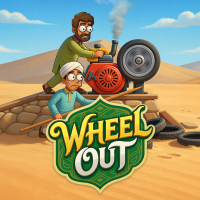
Wheel Out Game Icon

Wheel Out

Set your stake, press SPIN, and observe as the wheel travels the desert track automatically

AUTO
Resolution
INSTANT
Round Type
96.5%
96.5%
Desert wheel game from INOUT GAMES Play Wheel Out

Track Elements Explained

Every wheel journey encounters symbols that add value, multiply totals, or introduce sudden penalties

Adder Symbols

+1 / +2 / +5 / +10

FIXED GAINS
+1, +2, +5, +10 READ MORE
  • Adds a set amount to your total
  • Builds momentum gradually
  • Activated on contact
Learn How
Hazards on Track

Pigeon Penalty

CUTS TOTAL
/2 PIGEONS READ MORE
  • Divides your running total by two
  • No way to avoid mid-round
  • Appears randomly on track
View Details

What Makes Wheel Out Different

Wheel Out removes the complexity of split-second decisions and replaces it with pure anticipation. You choose your wager, optionally adjust the visual speed, then press SPIN. At that moment, control passes entirely to the game. The wheel rolls forward along a desert track, and you watch every collision unfold in real time. There is no joystick to steer around obstacles, and critically, there is no cash-out button to tap when you think the moment is right. The round simply plays out to its natural conclusion, whether that's a safe landing that pays your final total or a terminal hazard that ends everything instantly.

This automatic resolution model creates a unique kind of tension. You're not managing risk second by second; instead, you're committed from the instant you launch. As the wheel encounters +5 adders, your total climbs steadily. When it hits an x3 multiplier, the value jumps dramatically. But the /2 Pigeons can appear without warning, slashing your progress in half. A wall or pit means immediate failure. Because you can't intervene, every element on the track carries full weight. The game's viral appeal in India and Pakistan stems from this stripped-down, high-stakes format where each spin tells a complete story in seconds.

Understanding this hands-off mechanic is key. Wheel Out isn't about quick reflexes or timing a manual exit. It's about choosing your stake wisely, selecting a speed that suits your preference for how quickly the drama unfolds, and then watching the algorithm do its work. The speed setting doesn't grant you extra control—it only changes how fast the visuals play. Once SPIN is pressed, the outcome is already being calculated, and your role shifts entirely to observer.

Game Specifications

Attribute Value
Developer INOUT GAMES
Type Instant Wheel Game
Mechanics Automatic Track Resolution
Theoretical RTP 96.5%
Player Steering None (Fully Automatic)
Manual Exit Not Available (Auto Resolution)
Speed Control Adjustable visual pacing
Access Depends on platform and operator

What the 96.5% RTP Really Means

Wheel Out carries a theoretical Return to Player figure of 96.5%, a number provided by INOUT GAMES based on long-term statistical modeling. It's important to understand what this figure does and does not represent. The 96.5% RTP is a mathematical expectation calculated over millions of automated rounds. It describes the average proportion of all stakes that the game is designed to return to players over an extended period. It is not a promise for any single session, nor does it suggest that you will see a smooth, predictable return within a few dozen spins.

In reality, Wheel Out is built for volatility. The track layout deliberately creates wild swings. You might experience a string of rounds where the wheel crashes into a wall almost immediately, wiping out your stake with nothing to show. Then, without warning, a single round might thread through a series of adders, catch an x4 multiplier, and deliver a payout many times your original wager. This erratic pattern is by design. The 96.5% average only emerges when you aggregate thousands of outcomes; on a micro level, the experience is anything but average.

The absence of manual cash-out intensifies this variance. You can't lock in a decent result halfway through a promising run. If the wheel is showing a strong total but then encounters the /2 Pigeons, your value is halved instantly. If it's heading toward a safe zone but hits a pit at the last second, you lose everything. The Petarda Crow can introduce sudden visual chaos. Because every round must resolve completely on its own, the RTP figure serves as a structural baseline, not a session-level forecast. Approach Wheel Out knowing that short-term results will swing dramatically, and the 96.5% average only describes the game's long-term architecture.

How Track Symbols Work

No Mid-Round Decisions

Once SPIN is pressed, the wheel completes its entire journey without player input. You cannot steer, brake, or cash out early. The round resolves on its own terms, creating a spectator experience where anticipation replaces active control.

Adder Symbols

Scattered along the track are symbols marked +1, +2, +5, and +10. When the wheel makes contact with one of these, the number is added directly to your running total. These adders provide steady, incremental growth and form the foundation of any successful round before multipliers enter the picture.

Multiplier Symbols

The real drama comes from x2, x3, x4, and x5 multipliers. When the wheel hits one of these, your current running total is multiplied by that factor. A modest total built from adders can suddenly explode into a significant value. Multipliers are where the short-term variation becomes most visible.

The /2 Pigeons

This is the most punishing non-terminal hazard on the track. If the wheel collides with the /2 Pigeons symbol, your running total is instantly cut in half. It's a brutal reversal that can turn a promising round into a disappointing one, and there's no way to avoid it once the wheel is in motion.

Walls and Pits

Certain sections of the track contain walls and pits that act as absolute endpoints. If the wheel hits a wall or falls into a pit, the round terminates immediately. Your running total is lost, and the result is zero. These terminal hazards are the ultimate risk in every automatic journey.

Ladder Holder

Occasionally, the Ladder Holder symbol appears. If the wheel is on a path toward failure, hitting this element can save the round. It preserves your current total and effectively relaunches the wheel, giving you a second chance when it looked like all was lost.

Visual Style and Cultural Roots

Wheel Out's look and feel are inseparable from its mechanics. The game draws on a viral wheel concept that gained traction in India and Pakistan, and its visual language reflects that origin. The action unfolds on a rugged desert track, with sun-bleached colors and gritty textures that feel tactile and grounded. This isn't the glossy, neon-lit aesthetic of traditional instant games. Instead, the environment is sparse and intense, directing all attention to the wheel's progress and the symbols it encounters.

Every visual element reinforces the idea that once you launch, there's no turning back. The trajectory line is bold and clear, cutting through the desert backdrop so you can track every moment. When the wheel hits a +10 adder, the visual feedback is immediate. When the /2 Pigeons strike, the impact is visceral. The Petarda Crow introduces chaotic motion that keeps you on edge. INOUT GAMES designed the interface for mobile-first play, with a vertical layout that fits comfortably in one hand. There are no complex menus or distracting overlays—just the track, the wheel, and the unfolding result.

How a Round Unfolds

Before You Launch

  • Choose the stake amount you're willing to commit
  • Adjust the speed setting if you prefer faster or slower visuals
  • Double-check your choices—no changes are possible mid-round
  • Get ready to watch the entire sequence play out

After You Press SPIN

  • The wheel launches and begins traveling the track automatically
  • Watch as adders and multipliers change your running total in real time
  • Hold your breath if the /2 Pigeons or a wall appears ahead
  • Wait for the final outcome: a safe landing banks your total, or a hazard ends the round

About the Developer

Wheel Out is developed by INOUT GAMES. The studio's approach centers on simplicity and commitment: you set your stake, choose a visual speed, and press SPIN. After that, the wheel travels on its own. There's no steering, no manual cash-out, and no mid-round adjustments. The result is a focused, observation-driven experience where the track itself tells the story.

Common Questions

Does the wheel move on its own in Wheel Out?
Yes. After you choose your stake and press SPIN, the wheel travels the entire track automatically. You don't steer it, and you can't manually cash out partway through. The round resolves completely on its own.
What does the 96.5% RTP figure mean?
The 96.5% theoretical RTP is a long-term statistical average calculated by INOUT GAMES over millions of simulated rounds. It describes the game's overall payout structure but does not predict results for any single session or short sequence of spins.
Which company created Wheel Out?
Wheel Out is developed by INOUT GAMES.
What happens when the wheel hits the /2 Pigeons?
The /2 Pigeons symbol is a penalty hazard. When the wheel collides with it, your current running total is immediately divided by two, cutting your progress in half without warning.
Does adjusting the speed setting improve my odds?
No. The speed setting only controls how quickly the automatic sequence is displayed. It doesn't give you steering control, and it doesn't add a manual cash-out option. The outcome is determined by the track layout, not by the visual pacing.
What happens when the wheel crashes into a wall?
Hitting a wall is a terminal event. The round stops immediately, and any running total you had accumulated is lost. The result for that spin is zero.

Ready to Experience Wheel Out?

One-touch rounds. 96.5% theoretical RTP. Fully automatic track mechanics.

Start Playing

Must be 18 or older. Set limits and play responsibly.